
Broken Hill
Saturday 5 September, 7pm
Broken Hill City Art Gallery
HAYDN’S LONDON
Works for String Quartet & Flute by Haydn & Beethoven
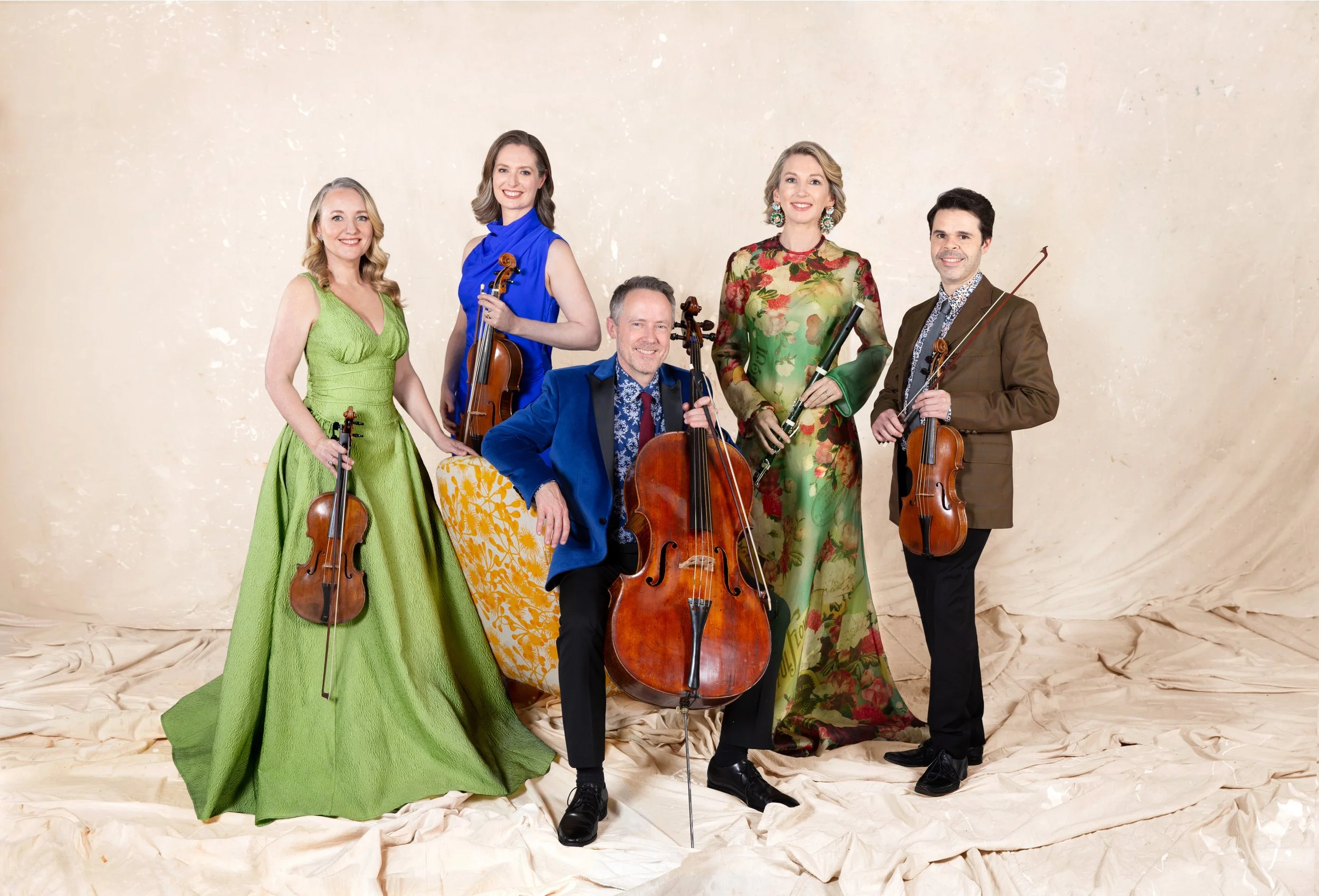
Haydn – String Quartet, Op. 33 No. 3 The Bird
Elena Kats-Chernin – Butterflying for string quartet
Beethoven – A Pastiche of Selections from String Quartet Op. 132
Marais - Les voix humanies (the human voice) for solo cello
Haydn – Symphony No. 104 arr. Salomon “London”
Skye McIntosh Violin
Ella Bennetts Violin
Rafael Font Viola
Edwina Cordingley Cello
Melissa Farrow Flute
ARTISTS
CONCERT DETAILS
Saturday 5 Sept, 7pm
Broken Hill City Art Gallery
Broken Hill
Address: 404 – 408 Argent Street, Broken Hill NSW 2880
ABOUT THIS CONCERT
Haydn liked to surprise his audiences. A playful pause, an unexpected turn of phrase, a melody that seemed to wink at the listener—his music is full of moments that delight as much as they impress. The concert begins with one of his most charming creations, the Bird Quartet (Op. 33 No. 3), whose fluttering figures and lively exchanges have long invited comparisons with birdsong. Written as part of the revolutionary Op. 33 set, these quartets transformed the genre into something at once intellectually sophisticated and irresistibly entertaining.
From birds to butterflies, Elena Kats-Chernin's Butterflying offers a contemporary reflection on nature's restless beauty. Characteristically vivid and imaginative, the work captures fleeting movement and shimmering colour, its textures constantly shifting as though carried on the breeze. Though separated from Haydn by more than two centuries, Kats-Chernin shares his gift for clarity, wit, and music that wears its craftsmanship lightly.
The programme then turns inward with selections from Beethoven's late String Quartet in A minor, Op. 132, a work born from illness, recovery, and profound personal reflection. Few pieces in the quartet repertoire travel such emotional distances. Alongside moments of searching intensity are passages of remarkable serenity, revealing a composer whose musical language had become both deeply intimate and astonishingly forward-looking.
A single voice remains in the spotlight with Marin Marais' Les Voix Humaines for solo cello. Originally written for the viola da gamba, this beloved miniature seeks to imitate the expressive inflections of the human voice itself. Unfolding with quiet dignity and understated eloquence, it forms an intimate bridge between the Baroque world and the deeply personal music that surrounds it.
The concert concludes with Haydn once again, this time on a grand scale. His final symphony, the magnificent London Symphony (No. 104), is heard in Johann Peter Salomon's chamber arrangement, preserving all of the work's energy, wit, and architectural brilliance in a more intimate setting. Composed for Haydn's triumphant visits to London, the symphony balances noble grandeur with rustic exuberance, its memorable melodies and sparkling invention reminding us why Haydn was celebrated throughout Europe.
Across more than two centuries, this programme traces the many voices of chamber music: birdsong and butterflies, song and silence, private reflection and public celebration. Together, these works reveal composers finding inspiration in the natural world, in the expressive power of the human voice, and in music's enduring ability to speak directly to the heart.


DEEP DIVE
Learn more about the Composers and Music in this performance from the following links:
Haydn Op. 33 String Quartets


AHE SPOTIFY PLAYLIST
CONCERTS 101: WHAT TO EXPECT
First time attending a concert and not sure what to expect? Don’t worry! Scroll down to find out about attending an AHE concert. If you have questions that you don’t see the answer to here, send us an email and we’d be happy to help. Contact one of our friendly team at: info@australianhaydn.com.au
-
Firstly, you should know there are no rules. Going to a concert can be a great time to glam it up. If that feels right, then go ahead – there’ll almost certainly be plenty of others dressing up.
It’s also totally fine to come in jeans – and plenty of people do. The only real “rule” is to wear something that’s comfortable.
-
Don’t worry – nobody is going to get into trouble for clapping in the “wrong” place. The only real rule is not to clap while the musicians are actually playing (as other people can’t hear them).
The thing to know is that applause conventions have changed over time. People used to talk all the way through the opera in the 1700s, and we don’t tend to do that now!
At AHE, the music we play will often come to the end of a section (known as a movement) with what feels like a ‘big finish’. It’s like the composer is begging you to respond. And in days of old, they may well have shouted or clapped or cheered at that point!
When that happens, and you “accidentally” clap and not many others do, you have done nothing wrong! Just sit back and let it all sink in. You may still feel the vibration of the music in the air, and it can be quite a magical moment.
The performers will be getting ready for the next movement, which may have a very different feel to it. That’s all part of the journey of the piece as a whole.
Think of it like a book, with each movement like a chapter. You save your Goodreads five-star review for the end – and that has now become the convention for clapping at concerts.
At the end of the work, there will once again be a lovely pause while the final notes die away.
Watch for the body language of the players and let that be your guide. The majority of people around you may also start clapping too – so that’s always a good sign to let go and express yourself.
You don’t have to hold back at all now! Feel free to clap as loud and long as you like, cheer or you can even stamp your feet on the floor while you are still seated if you really loved it!
Sometimes you’ll see people standing up and clapping too (called a standing ovation). You don’t have to do this, but when and if you do, just know that it’s the highest honour an audience can give the musicians and a sign of maximum appreciation.
Most of all – listen and enjoy!
-
Each performance has a detailed concert program that explains the history of the composers, the music and provides information about the musicians.
You can pick up a concert program at the performance or read it online a few weeks before the concert. Once, available, we upload it to our Concert Programs page and include it on the event page (above)
We also try to provide information about the music in the lead up to a concert on our website, social channels and via emails.
In our ‘Deep Dive’ section (also on this page for each concert), you will find links to various background information pages that will help to give you more insight into the works and composers on the program.
Be sure you have opted in to receive emails so that you get all the info.
-
Yes, depending on the venue. The availability of refreshments varies from venue to venue and changes from time to time.
Below is information about what is currently available at our own venues.
BERRY: In Berry, we have community-led catering which usually includes tea and coffee, wine, cakes and snacks served by our wonderful local supporters.
BOWRAL MEMORIAL HALL: Delicious pre-concert and interval homemade treats are provided by the CWA. Alcohol is not currently available. There are gluten-free options and you can pay by cash or card.
BURRAWANG, SCHOOL OF ARTS: In Burrawang, we have gorgeous community-led catering which usually includes tea and coffee, wine and snacks served by the wonderful hall committee.
CANBERRA: Wesley Music Centre. Interval tea and coffee is on the cards for this venue in the future!
CITY RECITAL HALL: In Sydney, the City Recital Hall operates a full service bar before the concert and at interval. You can even take your drink inside the concert! Note that the City Recital Hall is a cashless bar. More information on all the dining options and bars is available here.
LAKE MACQUARIE: Tea and coffee, wine and snacks available.
PORT MACQUARE: Tea, coffee and wine available.
-
Between pieces definitely. Our instruments aren’t amplified so we ask you to respect everyone’s experience and that you don’t talk whilst the musicians are playing.
-
Photos are fine between pieces and when the musicians are bowing at the end of pieces, provided the flash is off.
Our musicians are concentrating hard whilst they are performing though, so we ask that your phone is off and away during the performance itself.